The National Standard Examinations (NSE)
The National Standard Examinations (NSE) represent the first and most crucial step for Indian students aspiring to compete in the International Olympiads. Conducted annually by the Indian Association of Physics Teachers (IAPT) in collaboration with the Homi Bhabha Centre for Science Education (HBCSE), these exams identify the top scientific talent across the country.
Overview of the NSE Examinations
The NSE is divided into different subjects, targeting students at different stages of their schooling. All exams focus on deep conceptual understanding rather than rote memorization.
| Exam Code | Subject | Target Group |
|---|---|---|
| NSEP | National Standard Examination in Physics | Class 11 & 12 |
| NSEC | National Standard Examination in Chemistry | Class 11 & 12 |
| NSEB | National Standard Examination in Biology | Class 11 & 12 |
| NSEA | National Standard Examination in Astronomy | Class 11 & 12 |
| NSEJS | National Standard Examination in Junior Science | Class 8, 9 & 10 |
Essential Eligibility Rules
The DOB Rule:
Eligibility is primarily governed by a strict Date of Birth (DOB) bracket. For instance, NSEJS candidates must generally be under 15 years old. Always verify the current year’s specific age window in the official notification.
Flexibility & Limitations:
A student can appear for NSEP/C/B/A even if they are in Class 10, provided they meet the age criteria. However, once a student passes Class 12, they are no longer eligible for any NSE exams.
Single Session Path Rule:
In a single session, a student must choose only one path:
Path A: NSEJS (Junior Science) only.
Path B: Any combination of NSEP, NSEC, NSEB, or NSEA (Senior Science).
The 5-Stage Journey to the International Olympiads
India’s selection process is a rigorous filter that transitions students from national-level testing to global competition.
Stage 1: NSE (National Standard Examination)
The first screening round, conducted by IAPT.
Exams: NSEP (Physics), NSEC (Chemistry), NSEB (Biology), NSEA (Astronomy), and NSEJS (Junior Science).
Stage 2: INO (Indian National Olympiad)
The top ~300 students from Stage 1 qualify for these advanced descriptive exams organized by HBCSE.
Exams: INPhO, INChO, INBO, INAO, and INJSO.
Stage 3: OCSC (Orientation-cum-Selection Camp)
The top ~35 students in each subject attend a 2–3 week residential camp at HBCSE, Mumbai, for intensive theoretical and laboratory evaluation.
Stage 4: PDT (Pre-Departure Training)
The final team (typically 4–6 students) undergoes a rigorous "bootcamp" to refine experimental skills and problem-solving speed before going abroad.
Stage 5: International Olympiad
The official Indian team represents the nation at the world's most prestigious science competitions.
Events: IPhO, IChO, IBO, IOAA, and IJSO.
Why Should MHS Students Target NSE?
Early Competitive Edge:
The NSE syllabus is closely aligned with JEE (Advanced) and NEET, but with a greater emphasis on "out-of-the-box" thinking. Preparing for NSE makes school and entrance exams feel significantly easier.
Skill Transformation:
These exams promote logical thinking, conceptual clarity, and analytical skills, training students to handle complex experimental and theoretical problems.
Academic Prestige:
Scoring in the Top 1% (State-wise) or Top 10% (National-wise) earns students certificates of merit that are highly valued by premier global and Indian institutions like IISc and IITs.
Preparing for Success at MHS World School
The leap from school textbooks to NSE-level questions is significant. MHS World School provides a structured environment to bridge this gap:
- Advanced Laboratory Exposure: Since the later stages of the Olympiad involve practical tests, we emphasize hands-on learning in our state-of-the-art labs.
- Subject Specialists: Our faculty includes mentors who specialize in Olympiad pedagogy, focusing on the rigorous logic required for NSEP, NSEC, NSEB and NSEJS.
- Targeted Study Material: We provide students with previous years’ analysis and specialized modules that cover the "extra" topics required for the Olympiads.
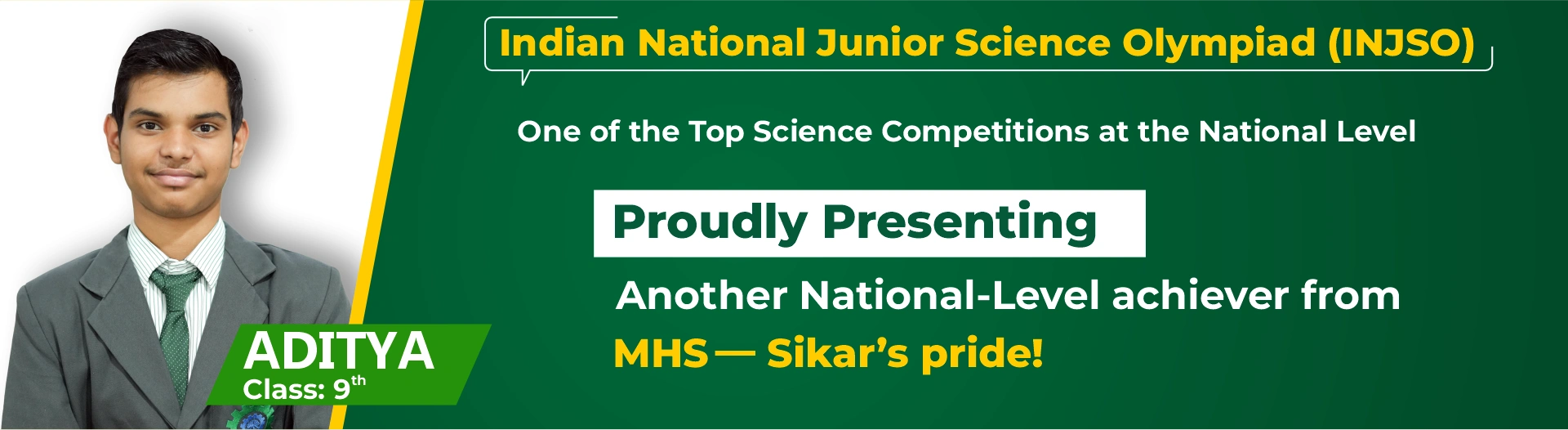
 Indian National Junior Science Olympiad 2025.webp)